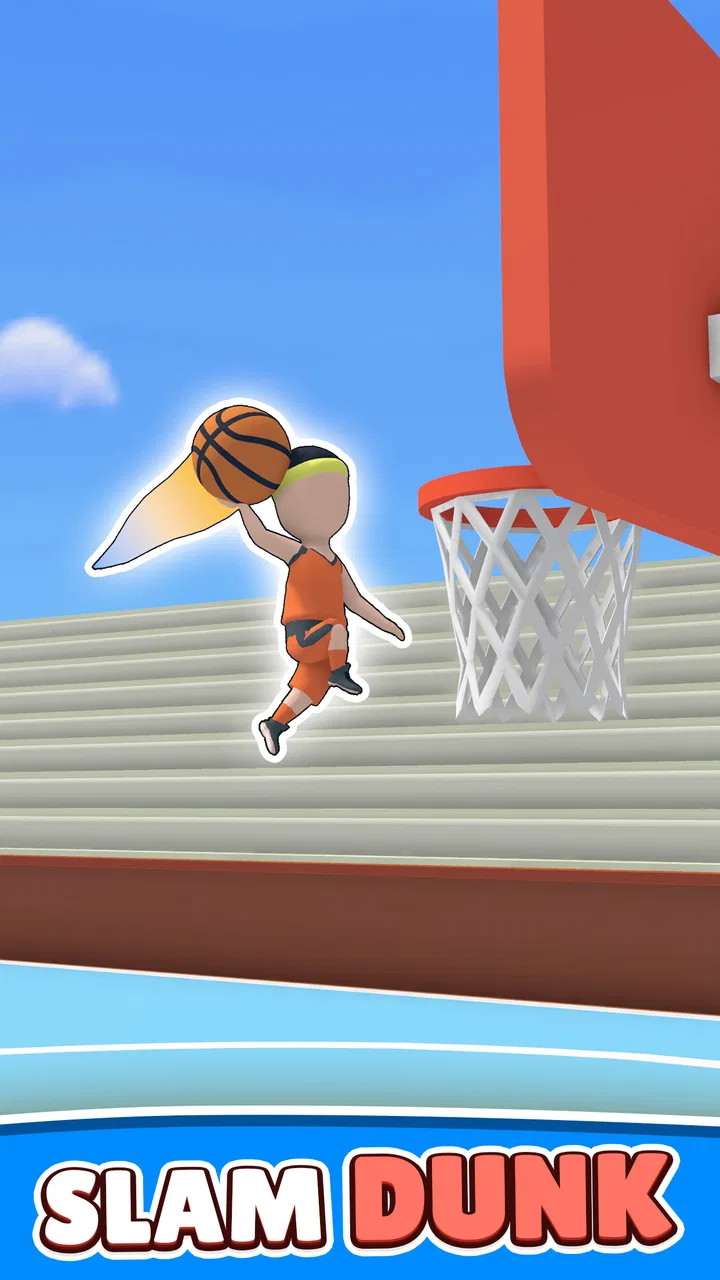
Basket Attack
- 4.0
- Rating
- 1.00M
- Installs
- Free
- Price

 Analysis by App-foxy
Basket Attack is the kind of sports game I can open without preparing myself for a long match. Its whole appeal is immediate: I attack toward the basket, look for the scoring opportunity, enjoy the quick response when the move works, and then decide whether I want to try again. That simple chain gives it an easy-to-understand rhythm, even though it also means the game will not satisfy everyone.
After spending time with it, I see the game as a compact arcade experience rather than a serious basketball simulation. It is published by Yso Corp, belongs to the sports category, and is free to play. The presentation is aimed at quick entertainment, not detailed team management, realistic league play, or a deep career system. That distinction matters because the right expectations make the short sessions much more enjoyable.
The game has reached over a million installs and carries an average rating of 4.0 from around 1.4 thousand ratings. It is suitable for Everyone, runs on Android 7.0 or later, and the current version is 0.5.1. Those details make it a fairly approachable choice for someone who wants a lightweight basketball-themed game rather than a demanding sports package.
You May Also Like

 Google Keep - Notes and lists
Google Keep’s Quiet Growth Shows the Appeal of Simpler Notes
As mobile work gets busier, Google Keep keeps winning a simple contest: capture a thought quickly, find it later, and get on with the day.

 Blood Strike: 2.5 Anniversary
Blood Strike’s Loadouts Turn Every Drop Into a Tactical Gamble
A close look at Blood Strike’s custom loadouts: how fast access to signature weapons reshapes its battle royale rhythm, rewards preparation, and narrows the gap between fights.

 Pandora - Music & Podcasts
Pandora’s Music Is Easy to Start, but Harder to Recover
Pandora’s strength is its low-effort path from a seed to a station. Its weak spot is how much confidence it asks you to place in connection, setup, and quiet recovery.

 8 Ball Pool
 Is Built on Rivalries, Rematches, and Routine
A close look at the rivalries, rematches, shared routines, and unanswered safety questions that turn a quick pool match into a persistent mobile community.

 Samsung Music
’s Quiet Strength Is Playing What You Already Own
Its reach comes less from spectacle than from dependable access to a personal library. That simplicity is both the app’s strongest retention engine and its ceiling.

 AccuWeather: Weather Radar
AccuWeather Review: A Quick, Clear Forecast for Everyday Decisions
For everyday plans, the best forecast is the one you can understand quickly. AccuWeather makes rain timing, radar, and local conditions easy to act on, with a few trade-offs.
More From Our News Desk



How the first attack sets the tone
The first thing I like about Basket Attack is that it does not ask me to learn a complicated basketball vocabulary before I can play. The central instruction is easy to understand: attack in order to score. That focus keeps the opening action clear. I am not choosing a roster, adjusting formations, or studying a large control scheme. I am trying to make the next offensive move work.
That simplicity is also the first important trade-off. In a full basketball game, the fun may come from passing patterns, defensive positioning, shot selection, and long-term improvement. Here, the pleasure is concentrated into the moment of attack. If you enjoy seeing whether a direct move produces a basket, the game gets to the point quickly. If you need a complete five-on-five experience, the narrow focus may feel thin.
I found the best way to approach the opening is to treat each attempt as a small timing and positioning puzzle, not as a simulation of an actual possession. The useful question is not “What would a professional player do?” but “What action does this situation invite, and how cleanly can I execute it?” That change in mindset helps the controls feel more natural and prevents disappointment when the game behaves more like an arcade challenge than a realistic court.
The first attack also tells me whether I am in the mood for this type of game. It is a good fit when I have a spare minute and want an uncomplicated objective. It is less suitable when I want a structured match with a beginning, middle, and final score. The game’s strength is its low barrier to entry, not its breadth.
The action is deliberately narrow
Because the main interaction revolves around attacking the basket, every attempt carries more weight than it would in a larger sports title. There are fewer layers between my input and the result. That makes success feel immediate, but it also exposes repetition quickly. I cannot rely on a long match, a changing lineup, or a tactical timeout to refresh the experience.
For that reason, I recommend playing in short bursts at first. A quick session lets me understand the movement and the expected attack without turning the limited loop into background noise. Once I know how the game responds, I can decide whether improving my consistency is satisfying enough to continue.
One practical tip is to avoid treating every failed attempt as a reason to rush the next one. The game’s compact format encourages fast retries, but pausing briefly to identify what went wrong makes the next action more purposeful. I pay attention to whether I mistimed the approach, chose an awkward line, or simply committed too early. That small habit gives the loop more depth than the short store summary suggests.
The feedback rhythm: action, result, and correction
The core rhythm works because the game gives me a clear relationship between action and feedback. I attack, the game shows me whether that attempt produced the desired result, and I immediately have a reason to adjust or repeat. There is no need to wait through a long sequence before learning whether my decision was useful.
That fast response is the game’s strongest quality. It makes a successful basket feel like a direct consequence of what I just did, while a miss or failed approach naturally invites another attempt. The feedback is not valuable only because it confirms success; it also helps me understand how to make the next attack cleaner.
I would not call the experience deeply strategic, but it does reward attention. A careless input can turn the attack into a poor opportunity, while a more deliberate move gives me a better chance of reaching the basket. The difference is subtle enough to encourage repetition, yet simple enough that a new player can understand the objective without reading a manual.
This is where the game compares favorably with more elaborate basketball alternatives. Larger titles can offer far more content, but they also place menus, tutorials, team choices, and match rules between the player and the immediate pleasure of scoring. Basket Attack removes much of that preparation. The cost is that it cannot offer the same variety or long-term tactical satisfaction.
Why the next attempt feels necessary
The next session begins for a straightforward reason: the previous action ends before I feel completely finished with the problem. If I score, I want to see whether I can repeat the result. If I fail, I usually have a clear suspicion about what I should change. That is a useful arcade design pattern because the game does not need a complicated narrative to create momentum.
The most effective sessions are the ones where I set a small personal target. I might focus on making the next attack more controlled, avoiding a particular mistake, or seeing whether I can maintain a better rhythm than in the previous attempt. These goals are modest, but they stop the experience from becoming mindless tapping.
There is a limit, however. If the feedback remains too similar for too long, the same fast retry that initially feels convenient can begin to feel repetitive. Players who need constant new opponents, courts, modes, or strategic choices may run out of reasons to continue sooner than players who enjoy polishing one simple action.
What the reward feels like in practice
The reward in Basket Attack is primarily immediate progress and the satisfaction of putting an attack together successfully. I do not approach it expecting the layered progression of a management game. The pleasure comes from the result arriving quickly after the attempt, followed by the temptation to reproduce it with less hesitation or fewer mistakes.
That reward structure suits casual play. I can fit it into a short break, use it as a quick change of pace, or play a few attempts when I do not want to commit to a full match. Because the game is free, it is easy to try without treating the download as a major investment. Its Everyone rating also makes the basic concept accessible to a broad audience.
Still, “free” does not automatically mean it will be rewarding for every player. Someone who expects a complete basketball universe may find the experience underdeveloped. The game’s reward is concentrated in execution and repetition, so its value depends on whether I enjoy improving a compact action rather than collecting a large amount of content.
A useful way to judge it is to ask how I react after a successful basket. Do I immediately notice a detail I could improve, or do I feel that I have already seen everything the game has to offer? If the first response is stronger, the loop has a chance to hold my attention. If the second arrives quickly, a more feature-rich basketball game would probably be a better choice.
Who gets the most from the reward loop
I think the game is best for casual sports fans, arcade players, and people who prefer a clear objective over a long tutorial. It also works for someone who wants a basketball flavor without learning a large set of controls. The short action-to-result cycle makes it approachable when I am tired or only have a little time.
It is less convincing for players looking for realistic rules, full matches, detailed statistics, or a persistent team-building challenge. Those players should look toward a traditional basketball simulation or a broader sports title. Such alternatives may demand more storage, attention, and time, but they provide the depth that Basket Attack intentionally leaves out.
Another specific use case is casual competition between friends who are together and want to compare quick attempts. The game’s direct objective is easier to explain than a complete basketball system. The limitation is that the appeal of that comparison depends on both people enjoying the same compact challenge; it is not a substitute for a full multiplayer sports experience.
The reset is part of the design, not a flaw by itself
After an attempt ends, the reset returns me to the same essential question: can I attack the basket more effectively this time? That reset is important because it keeps the game moving. There is little downtime between failure and another chance, so a mistake does not feel like a major loss of time.
I appreciate that structure when I am playing casually. A failed attempt can be irritating, but it is rarely discouraging because another try is close at hand. The reset also makes experimentation safer. I can test a different approach without worrying that one poor decision has ruined a long match or wasted a carefully built campaign.
The drawback is that the reset can make the game feel disposable if I am not actively pursuing improvement. In a deeper sports game, a loss may change the standings, affect a season, or reveal a weakness in my squad. Here, the consequence is more personal and immediate: I either refine the next action or stop playing.
My advice is to use the reset as a learning tool. Instead of restarting automatically, I take a moment to name one adjustment before trying again. That creates a simple action-feedback-reward-reset cycle: make the attack, read the result, enjoy or question the outcome, then return with one deliberate change. It is a small technique, but it gives the game a clearer sense of progression even when the broader structure remains light.
When repeating becomes friction
The same reset that makes the game convenient can become its main weakness. If I want a changing flow, a new tactical problem every few minutes, or a strong sense of unlockable advancement, repeated attacks may not be enough. The game asks me to find satisfaction in the quality of the action itself.
That means the title is not ideal as a primary basketball game for long evening sessions. I would choose it instead as a side game: something to open between tasks, during a short wait, or when I want a quick sports-themed distraction. The distinction is important because the game feels more successful when judged as an arcade loop than when judged against full-featured basketball releases.
The current version, 0.5.1, is also worth keeping in mind when deciding how much complexity to expect. I see this as a focused experience whose appeal comes from its basic interaction, not from a large ecosystem of systems. Players who enjoy compact games can appreciate that restraint, while players hoping for a constantly expanding basketball package should be cautious.
My verdict on the complete loop
Basket Attack succeeds when I want the whole experience to move quickly: attack, receive a result, feel the reward of a basket or the lesson of a failed attempt, reset, and decide whether one more session might go better. That loop is easy to understand and easy to revisit. It gives the game a friendly, low-pressure quality that suits casual Android play.
Its limitations are equally clear. The narrow focus leaves less room for tactical variety, long-term development, and the kind of match drama found in conventional basketball games. Repetition can arrive if I play without a personal goal, and the game is not the right choice for anyone seeking a detailed simulation or a broad sports career.
I would recommend it to a friend who wants a free basketball arcade game that can be learned quickly and played in short sessions. I would explain that the fun is not in managing an entire team; it is in making the next attack work a little better. That honest description is also the best way to decide whether it belongs on your phone.
For me, the final test is simple: after a successful attempt, do I feel curious about the next one? Basket Attack earns its place when the answer is yes. It does not need to become a full basketball simulator to be enjoyable, but it does need to keep that small spark alive—the feeling that one cleaner attack, one better decision, or one more controlled try could make the next basket more satisfying.
My recommendation: choose it for quick, focused sports entertainment, and skip it if you need a complete basketball season in your pocket.
FAQs for Basket Attack
01What is Basket Attack and how does it work?
Basket Attack is an arcade-style basketball game available on both Android and iOS platforms. Players aim to score points by shooting basketballs into hoops within a time limit. The game offers various levels and challenges, each with increasing difficulty. Its intuitive controls and vibrant graphics make it engaging for users of all ages.
02Are there any in-app purchases in Basket Attack?
Yes, Basket Attack includes in-app purchases. While the game is free to download and play, users can purchase additional features like power-ups, new levels, and cosmetic items. This can enhance the gaming experience but is not necessary to enjoy the core gameplay.
03Does Basket Attack require an internet connection to play?
Basket Attack can be played offline, allowing users to enjoy the game without an internet connection. However, certain features, such as leaderboards and updates, require an internet connection to function. It's ideal for on-the-go gaming without worrying about connectivity issues.
04Is Basket Attack suitable for all ages?
Basket Attack is designed to be family-friendly and suitable for all ages. Its simple mechanics and lack of violent content make it appropriate for children, while challenging levels can also keep adults entertained. Parental controls can manage in-app purchases for younger players.
05How can I improve my skills in Basket Attack?
To improve in Basket Attack, practice consistently to get familiar with the controls and mechanics. Focus on timing your shots precisely and aiming for the bonus hoops that appear during gameplay. Utilize power-ups wisely to boost your score, and replay levels to master each challenge.
Pros
- Intuitive controls for easy gameplay.
- Vibrant graphics enhance user experience.
- Regular updates with new features.
- Engaging multiplayer mode.
- Lightweight
- doesn't hog resources.
Cons
- In-app purchases can be pricey.
- Occasional ads interrupt gameplay.
- Limited offline functionality.
- Some levels feel repetitive.
- Requires constant internet connection.

Basket Attack
Gallery